

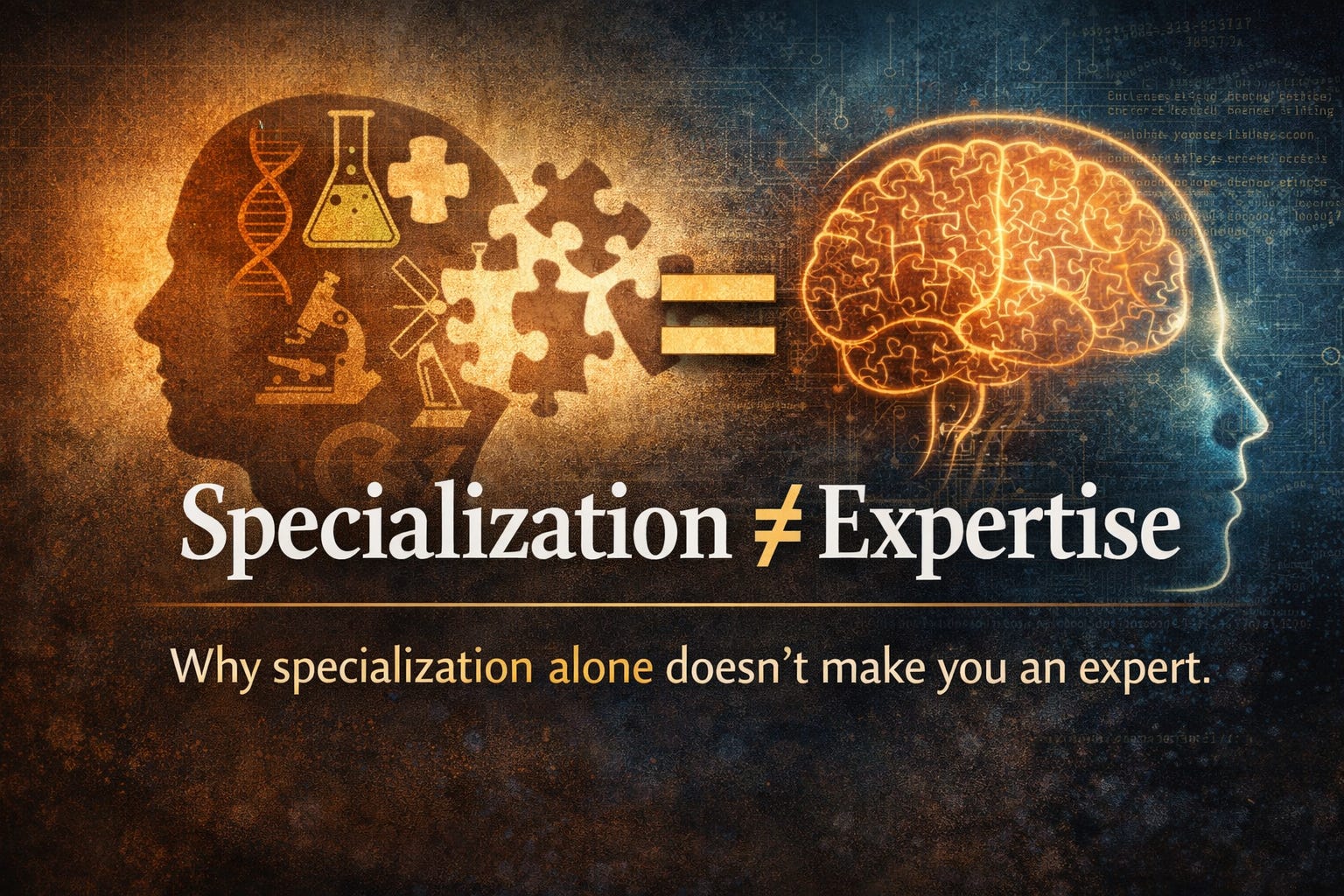
We’re told that expertise comes from doing one thing, repeatedly, for years.
The logic is simple:
More time = more skill = better.
It’s intuitive and widely accepted.
And incomplete.
The Conventional Model
The traditional view of expertise assumes:
Focus on one domain
Eliminate distractions
Accumulate hours
Become exceptional
This model works up to a point. It carries an assumption that goes unexamined: Depth in a single domain is the most reliable path to capability.
Where It Breaks
In many fields, the first years of effort produce the largest gains. After that, returns begin to diminish. You become more refined, not more effective. At the same time, the problem space around you is not isolated.
Real-world problems:
involve cross domains
have trade-offs
require interpretation
A system optimized for depth in each area can struggle when a problem doesn’t fit neatly within one.
The Overlooked Mechanism
Some of the most valuable insights don’t come from going deeper. They come from seeing across. When someone works in multiple domains, something different happens:
Patterns repeat in different forms
Assumptions become more readily visible
Solutions transfer
An engineer who writes music thinks differently about structure.
A climber approaches risk differently than someone who only studies it.
A builder sees constraints that a designer might not.
This is not dilution.
It’s expansion of the problem space you can recognize and navigate.
Depth Still Matters
This is not an argument against expertise. The question isn’t: Should you specialize or not?
The question is:
What combination of experiences improves your ability to understand and solve problems?
What Expertise Actually Looks Like
Expertise is treated as knowing more about a single subject or craft than anyone else. It’s considered knowing what matters and what doesn’t. That ability rarely comes from a single line of experience. It comes from:
contrast
comparison
exposure to different domains
A Different Way to Think About It
Instead of asking: “What should I focus on?” Ask:
What patterns show up across different domains?
What assumptions only exist inside one field?
Where does experience in one area improve judgment in another?
The goal is not just to become skilled.
It’s to become useful and effective.
Final Thought
The belief that doing one thing is the only path to mastery is a model. Like most models, it works until it breaks. Some of the most capable people are not defined by a single domain. They are defined by their ability to move between domains and to see what others miss.
The question isn’t how deep you go in one area.
It’s whether you’re developing the ability to recognize and solve the problems that matter.
If depth alone isn’t enough, what does better thinking actually look like?
Some of history’s most impactful thinkers approached problems differently.
I’ll explore that next.
Daniel Stih is a systems-level thinking partner who helps leaders and teams solve the right problem before committing time, money, and effort. His work focuses on clarity, problem framing, and decision-making in complex environments.