

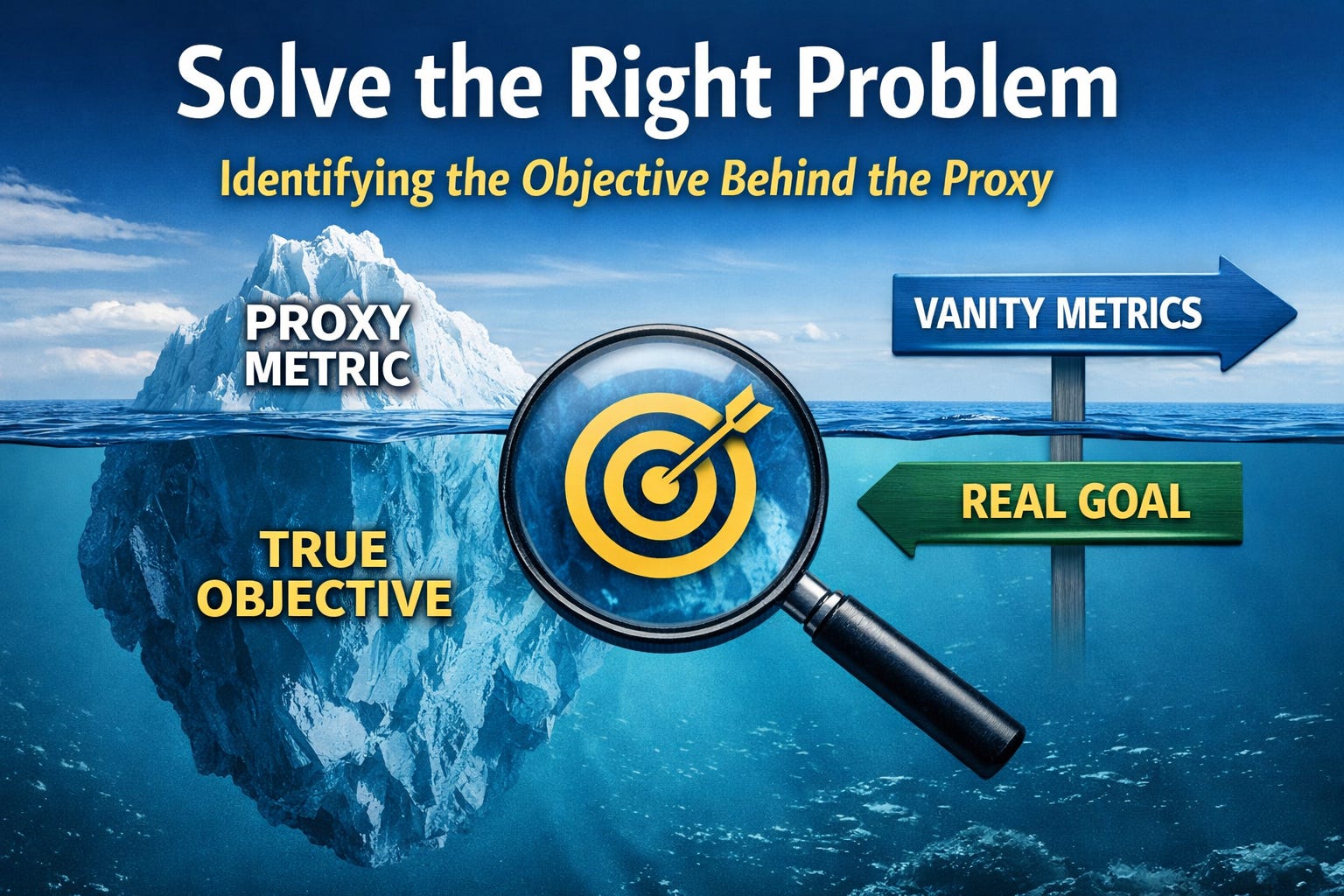
Most failures are not due to lack of effort — they come from working toward the wrong objective.
The Pattern
Most complex failures do not begin with poor execution.
They begin when a substitute objective quietly replaces the real one.
Execution is visible.
Framing is not.
By the time a failure appears, the effort behind it may have been disciplined, intelligent, and well-funded. The system delivered exactly what it was optimized to deliver.
The problem isn’t motion - it’s direction.
The Proxy
A proxy is a measurable substitute for something harder to measure - the real problem.
Revenue becomes a proxy for adding value.
Engagement stats become a proxy for usefulness.
Speed becomes a proxy for progress.
Compliance becomes a proxy for actual safety.
Proxies are not wrong.
They are incomplete.
Proxies simplify complexity.
They make coordination easier, and allow progress to be tracked.
The danger is once a proxy becomes embedded in dashboards, reporting structures and incentives, it begins to shape behavior. Over time, the proxy is no longer a measurement of the original and true objective.
Then the proxy becomes the objective.
How Drift Happens
Drifting from the objective doesn’t happen because teams are careless. It happens as proxies are:
Easier to measure
Easier to align teams around
Easier to justify to stakeholders
Less politically uncomfortable
Faster to optimize
The real objective may be slower-moving, systemic, and harder to define.
The substitute becomes concrete.
Once reporting, incentives, and accountability align around that substitute, challenging the proxy feels disruptive and irresponsible. The system begins optimizing the proxy with increasing precision. Effort compounds inside the wrong frame.
When Execution Becomes the Default Diagnosis
When outcomes stall, the first instinct is to improve execution:
Move faster.
Work harder
Align team spirit.
Increase accountability.
Push through resistance.
Pushing on execution feels responsible. It’s measurable. It gives leaders something to adjust. In complex systems, this compounds the problem. If the objective is mis-framed, and the proxy has replaced it, pushing harder does not correct direction - it increases momentum inside the wrong frame:
Meetings multiply.
Pressure increases.
Isolated optimizations accelerate.
System-level outcomes remain unchanged.
The problem is never effort. It’s clarity. Execution bias persists because framing is invisible work.
Speed looks like progress.
Thinking does not.
Where the Drift Hides: Assumptions
Objective drift is reinforced by hidden assumptions.Assumptions rarely announce themselves. They sound like facts:
“That’s how this works.”
“We don’t need to revisit that.”
“That’s not up for debate.”
Assumptions narrow attention and possibility. Over time, assumptions become embedded in language. Statements compress complexity into certainty such as:
“The only viable option is to scale.”
“The only way to fix this is to ____.”
“The only solution is ______.”
Each word carries an unexamined assumption and framing structure.
Only. Viable. Fix. Solution.
When those terms go unquestioned, entire categories of alternatives disappear. The system begins operating inside a box, and no one remembers drawing it.
Cross-Domain Examples
Product
A team increases engagement. User usage rises. The dashboard looks strong. User trust quietly declines. Engagement was standing in for true value. The proxy improved. The objective did not.
Urban Planning
A city reduced permitting time. Approvals accelerated. Projects moved faster. Affordability remained unchanged. The speed at which permits were issued was standing in for access. The constraint preventing progress was elsewhere.
Corporate Safety
An organization reduces reported incidents. Metrics improve. Leadership celebrates. The corporate culture collapses. Lower incident counts were standing in for safety. The proxy suppressed reporting.
In each case, the effort was real and execution was disciplined.
Misalignment began upstream.
When the Fix Sounds Right — and Still Can’t Work
Most failed solutions aren’t foolish. They’re plausible. They treat a visible symptom. They align with incentives people can see. They feel responsible. That’s why they survive longer than they should.
In complex systems, a fix fails because it targets the symptom while ignoring the forces producing it. The system responds. It routes around the fix. It amplifies pressure elsewhere. It produces a new failure mode that looks unrelated.
Safety rules increase paperwork - not safety.
Process changes slow production without improving quality.
Technical patches fix edge cases while degrading reliability.
The issue isn’t effort or intelligence. It’s that the solution was designed without asking: What would this fix have to survive once it hits the real system?
Real systems push back. They contain incentives, time pressure, legacy decisions, and human behavior that do not appear in design reviews.
If a solution only works if people behave perfectly, nothing else changes, and the environment stays stable - it is not a solution - it is a temporary illusion.
The Best Practice Illusion
Best practices are optimized for the average case. They assume stable conditions, repeatable scenarios, and known trade-offs. That is why they work — until they don’t. When under pressure, novelty, best practices become liabilities.
They suppress dissent.
They reinforce assumptions.
They lock teams into patterns that no longer fit.
Confusion sets in when organizations mistake:
Experience for applicability.
Precedent for fit.
Compliance for understanding.
A process that once aligned with the objective now quietly becomes a proxy for it. The team follows the practice faithfully, and the intended outcome drifts further away.
Why Smart Teams Miss It
We assume intelligence protects us. It does not. Highly capable teams are more vulnerable to objective drift.
Experience creates fluency.
Fluency creates shortcuts.
Shortcuts harden into beliefs.
Once a proxy is accepted as the objective, intelligence optimizes inside it.
The model becomes consistent.
The roadmap becomes logical.
The argument becomes persuasive.
Internal coherence is not correspondence with reality. A system can compile, run, and pass its own tests, and still fail externally. This is elegant wrongness.
Everything fits together.
Everything makes sense.
Except the objective was never pressure-tested.
The smarter the team, the faster and more beautifully this happens. Competence increases speed. It does not increase frame awareness. That is a separate discipline.
The Acceleration Effect
Highly capable teams are especially vulnerable to execution bias.They are trained to decompose problems, optimize components, and move decisively. These strengths work beautifully when the objective is sound.
When the objective is misaligned, those same strengths amplify error:
Speed increases.
Dashboards improve.
Confidence rises.
The system fails faster.
Strong execution on a flawed frame does not fix the problem - it reduces the time between decisions and the consequences.
Recognizing the Error in My Own Work
There was a time when I believed solving the visible problem was enough. The model was coherent; The reasoning sound;The proposal well-structured. What I hadn’t questioned was the objective itself. When the outcome failed to shift, it wasn’t execution that was weak — the frame was wrong.
That experience changed how I approach complex decisions.
Confidence is not clarity. Clarity begins upstream.
When Effort Increases but Outcomes Don’t Improve
A common signal of objective drift is asymmetric effort:
People work harder.
More resources are applied.
Execution improves.
Outcomes remain flat.
At that point, the constraint is rarely resources. It’s a framing error or an assumption shaping the system’s boundaries.
Teams interpret stagnation as resistance.
They respond with pressure.
What actually needs pressure is the definition of the problem.
When clarity returns, something surprising happens.
Execution doesn’t become harder.
It becomes easier.
Work that once required constant oversight begins to flow. Decisions stop ping-ponging.
What changed was not motivation. It was understanding.
Diagnostic Questions
Solving the right problem requires asking upstream questions. Not about execution — about framing.
What are we measuring that stands in for something harder to measure?
If this metric improves, what might still be broken?
What must be true for this framing to be correct?
What are we treating as fixed that might not be fixed?
Who benefits from the current definition of the problem?
What would cause us to redefine success?
Are we improving the system or its proxy?
These questions restore deleted information. They expose assumptions. They reopen possibility without destabilizing momentum.
Why This Matters
Most teams diagnose failure by asking: What went wrong?A more revealing question is: What did we assume had to be true for this to work?
That question shifts attention upstream. Instead of adjusting execution, it examines the frame. Framing errors are quiet.Execution errors are visible. By the time framing errors surface, resources have compounded inside them.
Financially.
Politically.
Reputationally.
The first risk in complex systems is not poor execution. Directional errors are more expensive than execution errors. They compound before they’re seen.
It is objective mis-selection.
The Discipline
Before optimizing effort, validate the objective. Make clarity precede speed.
Execution strength and analytical power matter. Competence without scrutiny of direction scales error. The most dangerous mistakes in complex systems are not sloppy - they are elegant. This is not an argument against execution. It is an argument about sequence. In complex problems the sequence should be:
First comes clarity.
Then alignment.
Then execution.
Reverse that order, and activity replaces traction.
Strong teams are not immune. They simply move faster inside whatever frame they accept.
Clear objectives are revealed while exploring ideas — testing options against constraints, surfacing hidden assumptions, and noticing where the system resists.
Solve the right problem before you solve it well.
Effort compounds when it aligns with what you are actually trying to change.
Clarity begins when you see the objective behind the proxy.
Daniel Stih is a systems thinker who explores how to solve complex problems. He works with leaders on live initiatives to clarify objectives and test assumptions when something feels off or they’re about to scale, to ensure they’re solving the right problem.